A Japanese Blogger's Analysis of Kagemasa Kozuki's Interviews
The following blog posts, originally written in Japanese, were published by a Hatena user named "amd-ryzen".
Below is an English machine-translation of the text.
Special Edition: The Legend that "Konami's President Hates Video Games"🔗
Published: 2019-04-13
Have you ever heard a story like the one in the title? In fact, unlike most stories like this, it's not a complete hoax, and if you trace it back, you can find an anecdote that seems to be the source.
"Konami's Charismatic Management Crumbles" — NIKKEI
Although this is a paid article, by registering you can read 10 articles for free per month, so I will quote some of them here.
"Gaming had a bad image, so I couldn't even tell my children what my job was," Kozuki said in 1999, looking back on the time of the company's founding.
(Omitted)
Mr. Kozuki was concerned about the public's perception that "games are just games", an alumnus of the company who was present at the management meeting confided, and he hated being called a "game dealer".
The above passage was reprinted all over the place, and the rumor spread that "Konami's president hates games and wants to stop making them."
There was a time when I explained that, "That's not what this sentence meant. In 1999, Konami had a hit rhythm game, and was also producing ambitious games for consumer devices. Now his children are following in his footsteps." What I meant was, "They used to think that way, but now they love games".
This interpretation was not entirely wrong, but it was somewhat naïve.
One of the reasons why such rumors are spreading in the first place is that "Mr. Konami is rarely seen in public". The interview he gave in 1999 is no longer available for direct confirmation, and I have only found one interview with him online.
If you read that one interview, you will understand what he really meant when he said, "gaming didn't have a good image, so I couldn't even tell my children what my job was" and "I hated being called a game dealer".
In 2005, Kigyoka Club featured Konami, and interviewed former president Kozuki (who is now the chairman of Konami Holdings and has retired from the front line). I recommend you read the whole thing, but I will quote some points that are particularly noteworthy.
INTERVIEWER: First of all, could you tell us what led you to enter the game industry and how your company was founded?
KOZUKI: In the Showa 40 era[i], I happened to be working at a record company, and when a machine known as the "jukebox" came out, I was put in charge of it. The jukeboxes were placed in restaurants and other places where people gathered, and customers would put 10 or 20 yen in the jukebox and listen to their favorite songs.
Konami was originally founded as a jukebox company.
INTERVIEWER: While American companies were doing the rental business, Kozuki's company was doing it on a for-sale basis.
KOZUKI: That's right. We failed and withdrew. Meanwhile, entertainment districts were established around the US military bases, and the machines from those bases spread throughout those areas. That was the beginning of game centers. So the jukebox is the origin of the entire game industry.
After failing to sell jukeboxes, they decided to switch to game centers instead.
INTERVIEWER: In 1981, your company, which had around 30 employees, hired 36 new graduates all at once. Why did you take such a bold step?
KOZUKI: At that time, newspaper advertisements alone did not bring in good people. The same was true for employment agencies. I say boldly, that there was plenty of work to be done, and promising prospects, but there were no people who could do it. Even if we recruited through newspaper ads, there was no motivation, no ability, and that was not going to help us, so we decided to build the company by hiring blank new graduates.
INTERVIEWER: But you were able to hire 36 people, which is impressive.
KOZUKI: So, at that time, the going rate for a starting salary was 120,000 yen, but we raised it to 140,000 yen.
INTERVIEWER: At that time, the difference of 20,000 yen was huge.
KOZUKI: That's why we were able to recruit them.
It is said that when they made the shift to making games, they needed a lot of people, so they raised salaries and attracted people, securing them all at once. The next point is important.
INTERVIEWER: Did you come up with any other ideas to attract students?
KOZUKI: In those days, jobs related to games were frowned upon, so we recruited as a company that manufactures electronic application equipment. There is actually an industry category called electronic application equipment, so they couldn't go wrong. We were able to recruit them because the starting salary was 140,000 yen, and the office was as shown in the picture (laughs). However, we interviewed in a hotel because we knew if they came to the company, they would find out what was really going on. We were happy just to have them come, so we didn't do a written test.
What is being talked about here is that "if you recruit people for a gaming company, they won't come". This point is important, and was also mentioned when Konami went public.
INTERVIEWER: Was the public listing a smooth process?
KOZUKI: When I first consulted an accountant about whether we could go public, they said, "No way, it's impossible ... You have no organizational structure, no internal audit system, and your small board of directors is not enough. There's nothing. Do you even have work regulations?" So we hastily put those things together. Since we couldn't go public in the field of games, we went public as an electronic application equipment company. So we listed ourselves as a company whose electronic application equipment is used in the game industry. So when we went public, our competitors were surprised and asked, "Can we go public in this industry?" and they all came to us to learn. Also, our lead underwriter was N Securities, and when they asked us about our competitors, we answered "Company S, Company N, and Company T"[ii], and then all the member companies of N Securities started going around to them and asking if they would like to go public. And then, they all followed our lead and went public.
The article talks about the situation at that time, when the company could not go public in the field of video games. Regardless of the president's mindset, you can see how little regard was placed upon games as a form of entertainment.
The interview then goes into the matter of the sports club takeover.
INTERVIEWER: Your company acquired People (now Konami Sports) in 2001 and began its sports business. This was a major turning point for the company. Can you tell us how it came about?
KOZUKI: Prior to that, our company had created a game in which you could lose weight. The idea was that you could lose weight just by moving your body while listening to music. At that time, we received calorie calculation and other know-how from People and jointly developed the game. One day, at a board meeting, the idea of making a game that allowed people to rehabilitate came up. As we were discussing how that was also an interesting area, we said that if we were going to do it, it would be better to make a game that would prevent people from getting sick. It just so happened that Mycal was doing poorly, and the idea of selling People came up. The health industry was an upcoming industry, and more importantly, it was an industry that would be accepted by society, which was appealing to me. Considering the days of jukeboxes, when residents told us not to build anywhere near them, a fitness club that was not opposed anywhere was very appealing.
The diet game was Dance Dance Revolution, and it was mentioned in another article that they came into contact when they went out to sell Dance Dance Revolution to fitness clubs. The important thing here is that "in the days of jukeboxes, there were even voices of opposition from residents."
Putting all these stories together, we can come to a different interpretation: Kozuki was "growing Konami as a game company by somehow escaping the term 'game' in an era when games as entertainment were looked down upon by others".
It is true that "the image was not good, so he could not tell his children what his job was". If it had been known that his company was a games company, his children might have been bullied. It is also true that "he hated being called a games dealer". Because he would not have been able to make his company big if he had been called a "games dealer".
Considering the historical background, when I look at what former President Kozuki has done, I cannot criticize him and say, "This president hates games! I can't forgive him for hating games!" At the same time, I cannot remain with the shallow level of interpretation that "he likes games now." It is easy to understand that how much President Kozuki has devoted himself to the entertainment of games cannot be explained by likes and dislikes.
Former President Kozuki is now in his 80s. It is not surprising that he might pass away soon. Given that, if rumors continue to spread that "Konami's president hates games," it would be an insult to a senior who has contributed so much to the game industry... That's why I decided to write this blog post. I hope it will clear up some of the rumors.
Special Edition: A Requiem for The Legend that "Konami's President Hates Video Games"🔗
Published: 2021-05-06
It's been a while since I wrote the previous article. It received a lot of attention, and I think it helped to dispel some of the rumor that "Konami's president hates games".
This article is a continuation of that. (So if you haven't read the previous article, I would appreciate it if you could take a look at it.)
Now, in my last article, I talked about the history of how Konami managed to grow as a game company by escaping the expression "game," but how exactly it became involved in games remained a mystery. In fact, there is no information on the Internet about the inception of Konami's involvement in games. Wikipedia only briefly describes how the president walked the path of games, and that's it.
So, I ordered various materials related to Konami from the National Diet Library.
Nikkei Venture (March 1999, p.64)
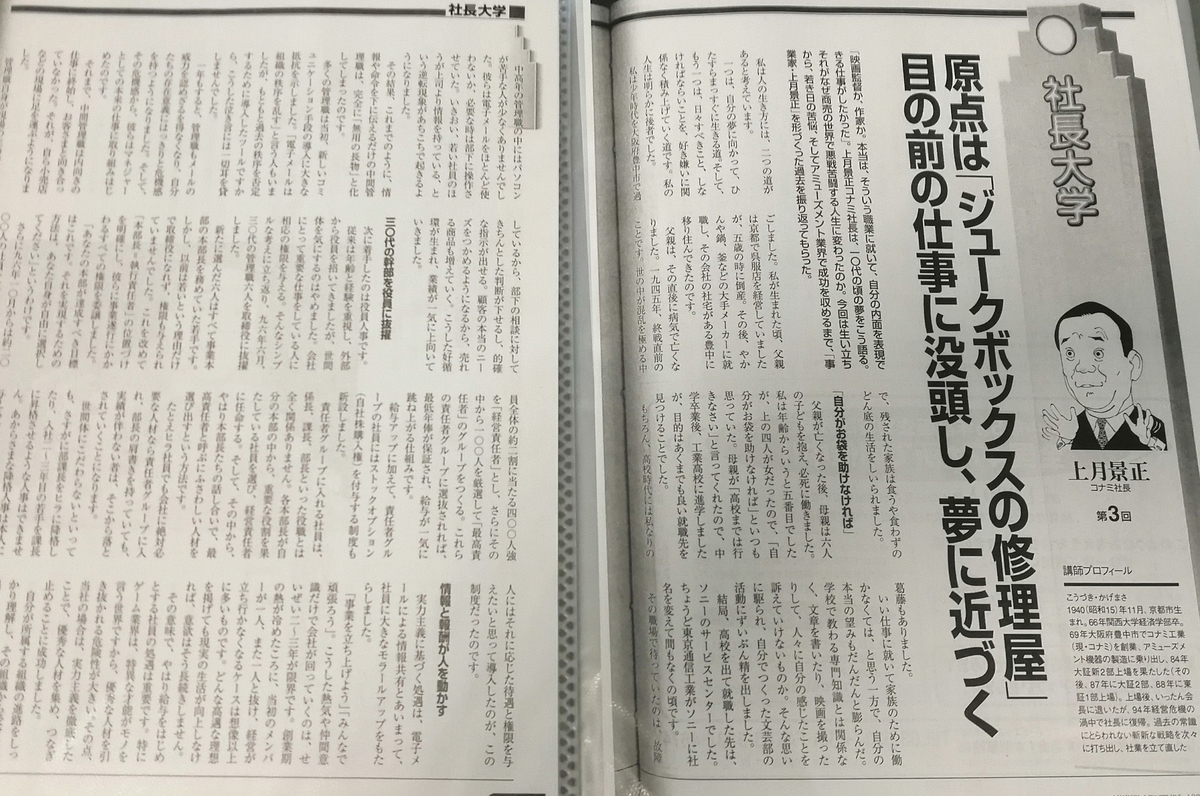
They offer an online service for sending copies, which is truly fantastic. Among the large amount of materials I have collected, I found an article in which current Konami Holdings Chairman Kozuki Kagemasa speaks directly about the founding of Konami. How did Konami enter the gaming industry? The January to April 1999 issues of Nikkei Venture (now Nikkei Top Leader)[iii] featured two stories about Konami President Kozuki Kagemasa, the latter one titled "President's University". I will use this article to explain the first story.
Let me begin by explaining Kozuki Kagemasa's upbringing. Kozuki was born in 1940, and his father died of illness in 1945, at the end of the war. His mother was working and had six children, and although Kozuki was the fifth child, he was the eldest son. His mother encouraged him to go to high school, and in order to find a good job, he went to a technical high school. At this time, he founded his own high school's literature club and was very involved in its activities. He says that it was at this time that his dreams of making movies and writing novels were born.
He then joined a Sony service center. His days consisted of simply fixing broken transistor radios, but he learned the job quickly and was promoted to section chief. In his third year, however, he discovered a correspondence course in a magazine and immediately enrolled in it. He was so amused by it that he asked the company for a month's vacation to take classes not only in correspondence courses but also on a real campus. He went to Keio University, stayed in a student dormitory, and watched plays after class... In this one month, he had a real, enjoyable student life.
A fellow student that he met at this time told him about night school, and so he enrolled in Kansai University's night school. He worked during the day and went to school at night.
Just before graduating, an acquaintance invited him to join Nippon Columbia, where he was soon put in charge of selling jukeboxes. This was unsuccessful, however, and Columbia withdrew from jukebox sales as the market was not as large as they had anticipated. However, the jukeboxes that had been sold continued to function, so he was asked to support them. Thus Kozuki quit the company and started a handyman business that repaired the jukeboxes.
During his time at Columbia, he mainly sold to nightlife establishments and bars in downtown areas. One of his customers said to him, "Jukeboxes aren't enough. Do you have any interesting games?" So he tried making a small game machine that imitated a pinball machine (a "trivial item" according to the president), and it sold like hotcakes. Seeing this opportunity, Kozuki established Konami Industries, using his home as the headquarters. His capital was 1 million yen. Now, he was dealing in handmade game machines.
From then on, Kozuki continued to change with the times. He added motors to his spring-loaded arcade machines, and when video games appeared in America, he adopted that technology. When Nintendo made the Famicom, Konami immediately entered the market as a third party (Nintendo gave Konami preferential treatment as an early third party). These software sales allowed Konami to grow significantly.
Looking back on this journey, Kozuki says, "What I've done has been a series of 'hated jobs'". He would carry heavy jukeboxes around bars, and video games were called the "enemy of youth education" during the popularization of video games. But he always devoted himself to the work in front of him, concentrating only on maintaining and developing his business, and overcame the difficulties.
At the end of the interview, Kozuki said, "I've been feeling a strange sensation lately." He said that by working on the job in front of him, he was getting closer and closer to his teenage dream. Today's (this was in 1999) video games can be a means of expression that rivals even movies. He said that the jobs he had been doing to make a living - repairing radios, selling jukeboxes, and hand-making arcade machines - had somehow connected to his old dream of becoming a writer or a film director. He thought this was amazing, and he came to strongly feel that this was one way for people, and for business people, to live their lives.
This is the end of the story of the founding of Konami, but the "President's University" story also describes the turmoil at the time of the change of company presidents, the subsequent internal controls, and the huge losses caused by bad inventory at the overseas sales companies. It will only cost you about 1,000 yen including postage even if you copy the whole book, and I think it is worth it.
Mr. Kagemasa Kozuki's thoughts on games are not so shallow that they can be divided into two categories of "like" and "dislike". I hope you will understand how ridiculous the rumor that "the president of Konami hates games" is.
Did Konami Really Have a Game-Hating President?! A Look into the Dark History of Konami!🔗
Published: 2021-06-19
In my last two articles, I repeatedly spread the message that the rumor which states "Chairman Kagemasa Kozuki, the founder of Konami, hates video games" is false, but after gathering various sources during this time, I discovered a rather interesting fact. That is, was it possible that at one point in Konami's long history there was a "president who hated games"?
You may be thinking, "What are you talking about now?", but please read on until the end. This is the story of the dark history of Konami, a history that Chairman Kagemasa Kozuki has never stopped regretting.
When you hear the name Konami from 1988 to 1994, what image do you have of the company? Probably a wonderfully positive image. In the arcades, Gradius II and other masterpiece STGs were released one after another, and on the Famicom, they made the most of their permission to manufacture in-house cartridges to provide a wide range of titles with extended sound capability with a unique identity, and towards the end of the Famicom era, they released the masterpiece Lagrange Point, which was equipped with an FM sound source as it was. The company also released numerous masterpieces for the Super Famicom, including the Ganbare Goemon series, Contra Spirits, Teenage Mutant Ninja Turtles, Madara 2, and Pop'n Twinbee, and also entered the PC Engine market with the Snatcher CD-Romantic, which could be called a completed version of Snatcher, and the arrival of Tokimeki Memorial, which sparked a huge boom... this was truly a period when Konami was on a roll.
Tokimeki Memorial may have been fine and dandy. However, during this period, an invisible time-bomb was quietly and slowly ticking away within the company.
To explain this, we must first go back in time to 1984, when Konami was newly listed on the Second Section of the Osaka Securities Exchange. At that time, the founder, President Kagemasa Kozuki, had begun to think about relinquishing the position of president and having someone else assume the position of president. This was because becoming a publicly-traded company meant greater social responsibilities and more external interactions for the president. At the time, there were very few presidents in their 40s among publicly-traded companies, so President Kozuki was worried that "if a greenhorn like me was the face of the company, people would look down on us."
And in fact, before the company was listed on the Second Section of the Tokyo Stock Exchange, Kozuki actually stepped down as president in June 1987. He remained with the company as chairman, and the position of president was passed down to Fumihiro Hishikawa. Mr. Hishikawa had been the Director of the Planning Department of the Hyogo Prefectural Government and the Director of the Hanshin Prefectural Citizens Bureau, and he joined Konami by way of fate. At that time, President Kozuki had scouted various management executives from large companies and various financial institutions in preparation for the company's listing. The decision was made that although Konami was still developing its own employees, they were too young to become executives. 63-year-old Hishikawa, who was serving as chairman at the time, was already an executive. Then, he was appointed president due to his competence, as well as for the dignity that came with his age. In other words, the roles of chairman and president were reversed.
Kozuki recalled of the time, "I believed that by dividing that role between two people with different abilities and qualities, we could manage the business better than ever before". However, he also reflected that this was "a sign of weakness, wanting to escape the pressure of being the head of a publicly-traded company". Kozuki was more concerned about public appearances than anything else. To me, this seems to be a continuation of the company's past business of providing jukebox services and selling hand-made game machines.
There were no problems for the first year or two after the new system was started. However, in the third year, something began to go wrong between President Hishikawa and Chairman Kozuki. Whenever the chairman had a visitor, Kozuki would get in between them, saying, "I'll tell the chairman myself," and would not let the two meet. He would also warn employees, "all reports must go through me". Kozuki was concerned about the two-party system, so he would only say to employees who came to him for advice, "Please consult with President Hishikawa before making a decision". He would give direct advice only to Hishikawa.[iv] However, this attitude left many employees wondering, "What on earth is he worried about"? There were even rumors going around that "President Kozuki was ill and would not recover". Kozuki later speculated that, in essence, Hishikawa, who was nothing more than a hired president, wanted to demonstrate his power to the executives and directors of his previous organization.
This ultimately led to factional fighting, confusion among employees, and even Konami's image began to decline externally. The executives who had been brought in from the outside had little sense of what it was like to work in the games industry, and the voices of the younger employees who were creating the games were increasingly not being heard.
And gradually the financial results started to go wrong. The figures were certainly not bad. But compared to the growth rate of the overall game market, Konami's figures were not good enough. Then Chairman Kozuki came to a realization. The company's financial condition was deteriorating. The figures were certainly not bad. But this was just because the company was wholesaleing large quantities of products to overseas distributors. Consumers were not happily buying Konami products. Distribution stocks and inventories grew to enormous numbers.
It was clearly dangerous to continue like this, and in 1992 thus Chairman Kozuki made the decision to remove President Hishikawa from his post. However, even here, he did not take the option of returning to the company himself. Since the change of president was made on the day of the public listing, it was decided to ask someone else to take the reins again. Senior Managing Director Yasuo Nishimura, who in 1991 had joined Konami at the company's request (previously an executive at Daiwa Bank, the company's main bank) became president. He rose quickly through the ranks, taking only one year from the time he joined the company to his appointment as president. Hishikawa was appointed chairman emeritus and remained in an advisory role, while Chairman Kozuki remained in his role as chairman.
And rather than solving the problem, this personnel change only ended up deepening the wound.
President Nishimura, who came from a banking background, could not accept the situation of falling into the red as soon as he took office. He left a large amount of inventory as it was, and the other directors followed suit, following a management plan that did not reflect the devastating situation on the production floor and left the company with an attractive appearance. Moreover, Chairman Emeritus Hishikawa and President Nishimura took the same course, which delayed the inventory disposal process and made the resolution of the problem more and more difficult to resolve.
"...There is potential deficit in our overseas subsidiaries. And it's not just hundreds of millions, it's billions..."
As the founder, it was only he who could put an end to this problem. There was no way that Chairman Emeritus Hishikawa or President Nishimura could take responsibility. So he made a plan to demote President Nishimura temporarily, return to his position as president, and after dealing with this issue, bring back the experienced Nishimura (he had only been in the position for one year after all). After talking with President Nishimura, Chairman Kozuki returned as President Kozuki in June 1994. However, Nishimura quickly returned to Daiwa Bank. Daiwa Bank was furious, saying, "Why did you fire a manager who was consistently profitable"? Konami ended up having to terminate its transactions with Daiwa Bank.
With these events, Kozuki was forced to say, "those of us who were left behind were stunned". They had to somehow deal with the inventory of their overseas subsidiaries, but the amount just kept growing. They had prepared for a loss of about 8 billion yen, but they found even more dead inventory. From the perspective of the overseas subsidiaries, "The Japanese headquarters sent the goods without permission. This is not inventory. It's just products that were forced on us and moved over. We didn't buy it." They didn't even realize that it was dead inventory. This reckless pushing of inventory would have been acceptable at the dawn of the video game market, but 16-bit consoles had already reached their maturity and the next-generation Saturn and 64 consoles were beginning to loom in the shadows. In addition, Nintendo and Sega were bundling 2 or 3 software titles with their consoles in a battle for U.S. market share, which led to reluctance to buy and a price collapse. There was no room to sell off the inventory that had been recklessly pushed onto the market. In the end, Konami's deficit ballooned to 16 billion yen. Since net sales for that fiscal year were 27.7 billion yen, you can imagine how huge the deficit was. Kozuki said that Nishimura had anticipated this and had quickly returned to the bank.
Konami was in crisis. This was the result of placing more importance on social credibility than management ability in the hands of the president, and running away from pressure. President Kozuki said that it was a miserable experience that cannot be described as anything more than bitter. What's more, President Kozuki had been away from the workplace for seven years. A seven-year gap had created a wall between the president and the employees. His own ideas and management policies had not been communicated to the employees at all. From this point on, President Kozuki would launch various reforms to break out of the current situation.
One of these was the use of email. 350 computers were installed and emails were sent to all locations. At the same time, paper documents were eliminated and all emails and replies from employees were made public. A dedicated line was installed at the president's company housing so that emails could be checked 24 hours a day, and he responded immediately to emails from employees working late at night or overseas. Thanks to this, employees who had thought "there would be no reply until the next morning anyway" were surprised, and morale gradually improved, he says. And because of this, the role of middle management was reconsidered. Many middle-aged and older people at the time were not good at computers, so they felt aversion to exchanging emails, but they could no longer say that and began to go to the site to conduct management.
"I also looked at employees' daily reports throughout the day to understand the situation in the company. If I thought something was wrong, I would immediately step in, and after I had looked at almost all the employees' daily reports and finally decided that I had a good grasp of the situation, I instructed the employees to submit reports. There was a problem that it was difficult to write anything inconvenient when giving it to the superiors, so I had them put it in a report box and share it with all departments. Thanks to this, employees began to write down problems without hesitation, and we were able to share information on overall management trends across departments. This led to the spin-off of the development department and the introduction of an independent accounting system."[v]
President Kozuki then took steps to appoint directors. In June 1996, six managers were selected for the board of directors, all of whom were young and in their 30s (including Fumiaki Tanaka, who later served as president of Konami Digital Entertainment). He delegated all authority related to business operations to them. He then created a group called Executive Officers, and within that a group called Chief Executive Officers, and created a new salary system. Even if a person was an ordinary employee, if they were absolutely necessary for the company they would be placed in the group of managers, and even if they were a department manager, they would be demoted if they had no notable track record. Salaries were to be increased for those who were in charge of businesses with high profit margins, large sales, and high growth rates, and salaries were automatically calculated by entering financial data into a formula we had created. When the system was implemented as it was, the annual salary of one executive was 100 million yen, which was far more than Kozuki's annual salary, but he implemented the system as it was, without considering how to balance it.
These reforms were successful. Konami continued to grow and make great strides as a video game company. At the same time, President Kagemasa Kozuki became the first chairman of the Computer Entertainment Supplier's Society of America (CESA), and continued to work energetically to protect the rights of game software and develop the computer entertainment industry.
Nishimura, who was president of Konami from 1992-1994, was only one year into his tenure as president. And he was 53 years old. The possibility that Mr. Nishimura, who came from a banking background and was 53 years old in 1992, is a game aficionado seems highly unlikely. If one were to seriously point to a "president of Konami who hates games," Mr. Nishimura would probably be the closest contender. However, I doubt anyone would mention his name. Perhaps this article is the first to point out on the Internet that Mr. Nishimura was the president of Konami.
Finally, I would like to conclude this article with these words.
Mr. Kagemasa Kozuki deserves our respect, but if you ask me if I want to work with someone who works so vigorously and too hard, I definitely don't want to.
Author's References:
- 参考文献:日経情報ストラテジー1997年6月号
- 日経ベンチャー1999年一月号-四月号 社長大学
- 日経ビジネス1995年7月31日号 敗軍の将、兵を語る