1 August 2002
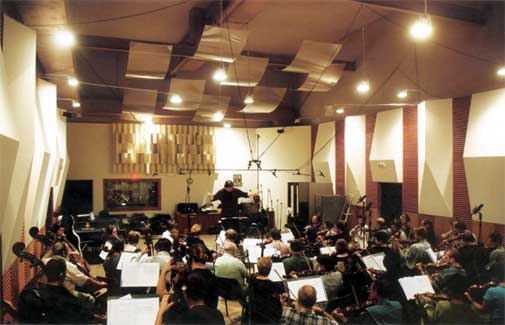
Without a doubt, the global economy has stretched its mighty arms beyond the boardrooms of billion dollar multinational corporations finding an odd new home in the lives of musicians. At prevailing rates, a New York or LA orchestra recording session can easily become financially prohibitive to a game developer. Furthermore, the current generation of multi-gigabyte sample libraries present such a dramatic improvement in sound quality that game developers and producers inevitably ask themselves “is it worth the extra $100,000 to record the soundtrack with a live orchestra”? Too often, the answer is no. If we are to raise the bar in orchestral game music, we must elicit a different answer.
When I approach a producer and tell him that with the time and money spent massaging samples and tweaking sequences we can record the entire soundtrack with a live symphony orchestra in a way that would require only marginal additional resources, suddenly “is it worth it” evokes a very different response. Inevitably after the initial reverent enthusiasm subsides, the producer is going to ask me how in the world I intend to do that. This is where the global economy comes into play.
Live orchestra recording is an extremely labor intensive production process. It requires 40, 50 or even 100 people to be working simultaneously to yield a finished product. Labor in the United States is strikingly expensive. If billion dollar multinational corporations can go to other countries to utilize the most cost-effective means of production, why shouldnít the creators of game soundtracks do the same?
This has been quite a hot topic lately. Among the most frequently noted places to record a symphony orchestra is Prague in the Czech Republic.
I’ve conducted and recorded film cues at the Fox Newman Scoring Stage with “A” list Hollywood session players. I’ve had Grammy award winning players and members of the New York Philharmonic follow my baton while recording music I have written for game soundtracks. So, when my friend and eminent producer Thomas Boecker invited me to write for, orchestrate and conduct the Prague Symphony Orchestra for Merregnon 2 , I was eager to experience first hand the ins and outs of a foreign orchestra recording session.
Contracting
The administrative process behind a live orchestra recording is quite colossal. In addition to a million minor details, someone must arrange for a studio and technical staff, coordinate the schedules of upto 100 players and make sure each one of those players has their respective music for each and every cue. Often this is the job of the orchestra contractor. In Prague, the contracting was excellent. Petr Pycha our contractor, is the Deputy Manager of the Prague Symphony so he has as much of an inside line on players and availability as one could expect. In addition to flawlessly attending to the aforementioned arrangements, he went way beyond the call of duty and arranged for hotel accommodations, sight seeing materials, and tours. He even acted as shuttle bus service to and from the airport and the studio. He was an extremely nice guy and I would highly recommend him.
Recording with the Prague Symphony presents definite issues the visiting composer, conductor and producer must be ready to deal with.
Tuning
In Prague, as in many East European cities and countries they tune to A442 or A443. In the US and some West European cities the tuning is to A440 or A441. If you are including synths in your final mix, keep in mind that synths tend to default to A440. If the orchestra plays at A443, you will hear either the orchestra or your synths as being slightly out of tune. As such, you can either request that the orchestra tune to A440 or retune your synths to A443. Asking an orchestra that is accustomed to A443 to play at A440 will lead to all sorts of intonation problems so you are well advised to retune your synths.
Technique & Style
I would say that the orchestra technique in a recording session is about 70% of that you would find in NY or LA. On simple cues there was no problem and the protocol was much as it is here. The first take was done to get the idea and put the cue physically in the hands of the players. The second take we would record but with an open ear for intonation and style. The third take was generally the good one and a fourth was done if necessary. On these simple cues, a 4-minute piece could be reasonably completed in ½ hour. The story changed dramatically as the cues got more complex. One of my more spritely pieces contained 16 bars of 16th notes at a tempo of 140 bpm. It was written in A minor and I took care to write in a way that would sit well in the players hands. In LA & NY the players would have read it down at tempo. In Prague, the first take at tempo was so disastrous that I had to rehearse them at 80 bpm then gradually increase the tempo in 20 bpm increments until we got to 140. It took me ½ hour to get the players to the point where we could record a first take. In the end, however, we got a very satisfactory result but it took about 80 minutes for the 4-minute cue.
This brings up a very important point. In Prague, even with click and the best orchestra in town, you must be, or have, a good conductor. As one colleague told me, “In NY and LA the job of a conductor is to tell jokes, keep the orchestra amused and stay out of the way” In Prague, the job of the conductor is to conduct. Your skills as a conductor will have a dramatic bearing on your recording. Players expect to see their cues. They don’t pick up on genres as fast so you must explain much more about the music. One of my cues was unquestionably in the West European impressionistic tradition. Whereas I don’t doubt the familiarity of each and every player with this genre, it simply was not native to the orchestra. As a result, I spent a lot of time balancing the ensemble and repeatedly requesting phrase and dynamic modifications.
Language
Language is an issue. A translator will save you a lot of time and is definitely worth the expense. We were very fortunate to have an excellent and much revered Czech score reader . He helped quite a bit with language issues and kept those in the booth informed about what parts of which takes were best. He also had a very good rapport with the ensemble and I called on him on a few occasions to come out to the sound stage to explain various issues.
We recorded at ICN Recording Studio, the home studio of the symphony. The sound stage is comfortable and the booth, although small, is functional. I wasn’t crazy about the room sound and unfortunately it wasnít equipped with moveable wall baffles . The recording technology was a bit behind. Having 2 DA88’s and going to 8 tracks with 32 mics forced us into situations where we had to choose whether to keep a take, or record over it with the next take. As well, very specific punch ins and outs were out of the question. I thought the advent of multitrack direct to disc systems put an end to those annoyances years ago…. alas one must be respectful of the place and situation and work within the confines defined therein. The engineers were professional and well mannered but there were repeated problems with click bleed. At one point I requested that click be sent only to my cans and not to the orchestra but, unfortunately, they could not make that happen. On the bright side, the sound in the booth that came out of their system was very very nice and quickly made me forget my apprehensions about the room.
Production
I was told to expect 3-4 minutes recorded for each 1 hour in the studio with the orchestra. I got 80 minutes of final takes in 15 hours or about 6 minutes per hour so I was very pleased. As well, in the end, I got an excellent sound and performance but, to be sure, I earned my wage!
The final result was really good although I had to work much harder and a bit longer to get to that result than I would have in NY or LA. I’m not at liberty to disclose the budget we had on this project but, the contractor would tell you that the cost, per player, per hour is around $15-20. On a 3-hour session that’s about 1/6th the cost of doing that $100,000 NY or LA recording session.
Prague is a wonderful city rich with treasures and history and is a great place to explore. A few extra days for sightseeing is highly recommended!
Conclusion
Is recording in Prague cost effective? Can you really get a finished soundtrack within the same budget confines as a guy with nothing but a synth? Yes but it depends entirely on the composer.
I can write pretty quickly and have the orchestration skills to write and orchestrate a 4:15 huge orchestral cue in about 2 days. Actual composition aside, with what would have amounted to 40 synth tracks, that very cue would have taken even the most experienced synth programmer 4 or 5 days just to sequence and produce in a manner that would yield an almost-real sounding synth recording. Instead, I spent 60 minutes recording that very same cue with a live symphony orchestra and, let me assure you, it sounds amazing! Essentially, I saved the producer 35-40 man-hours per cue by eliminating the synths and using a live orchestra. Multiply that number by 22 cues and I have now saved the producer around 800 man-hours. 54 musicians playing 22 cues in 15 hours is about 800 man hours. Do the math and you will see that Yes, with the right composer, you can really get that huge live orchestral soundtrack performed by a very respectable symphony orchestra within the same budget confines as a guy with nothing but a synth.
A Final Note
In a recent correspondence, a game producer confided in me that he was concerned that his composers on a certain project were not able to orchestrate their music properly for an upcoming live orchestra recording and asked if I would supervise the process. Indeed, a whole additional set of skills are necessary for a composer to write for real instruments. There is a very ironic catch 22 that confronts our industry. In order for orchestral game soundtracks to rise to the next level, we MUST move to live orchestral recordings. The catch 22 is that as the quality of sample libraries increases, the need to understand how to handle a real orchestra decreases. As such, there are fewer and fewer composers who actually understand orchestration. As a result, it is critical that we augment the terribly low supply of game composers who have all the skills necessary to bring us to that next level by encouraging and promoting the use of live instruments. In the current global economy, yesterday’s financial restrictions preventing developers from doing so are quickly dissolving.
Andy Brick, composer
www.andybrick.com
https://web.archive.org/web/20071107041157/http://www.music4games.net/Features_Display.aspx?id=48